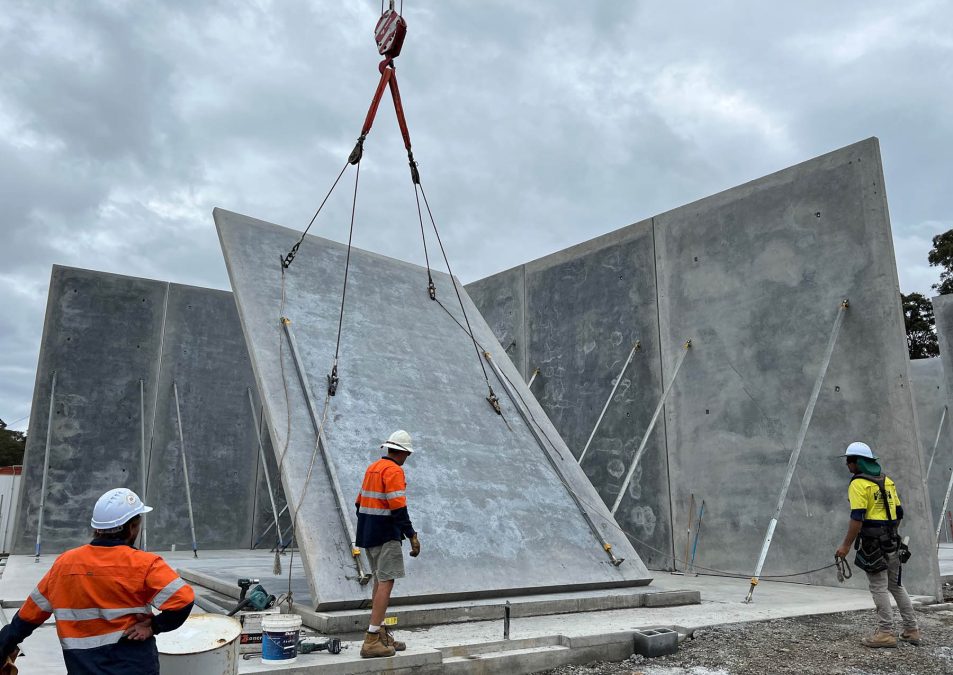
Concrete tilt panel construction is transforming the way commercial and industrial buildings are built. If you’re planning a project that demands speed, strength, and cost-efficiency, it’s time to consider this tried-and-tested method. Tilt panels are formed on-site, lifted into place, and become the structural and exterior walls of your building. With less transport, fewer trades, and shorter timelines, it’s no wonder this construction technique is being used in everything from warehouses to retail centres. If you’re exploring concrete tilt panel construction for your next project, get in touch with our expert team to discuss your site needs and timelines.
Concrete tilt panel construction is a building technique where large concrete panels are cast horizontally on a building slab and then tilted upright into their final position using a crane. These panels form the exterior shell of a building and often act as load-bearing structural elements. Unlike precast concrete, which is fabricated off-site and transported in, tilt panels are poured, cured, and installed all within the same location.
This method is especially popular for commercial and industrial buildings due to its speed, design flexibility, and efficiency. It allows builders to create large, uniform wall sections with fewer joints and enhanced durability. Once lifted, the panels are temporarily braced until the roof and structural systems are tied in, locking the building envelope together.
Concrete tilt panel construction begins with site preparation and the pouring of the building slab. This slab serves two purposes: it forms the building floor and acts as a casting bed for the tilt-up panels. Here’s a simplified overview of the process:
Once the panels are in place and the roof is attached, the bracing is removed and the structure is complete. This method requires coordination, precision, and experience to ensure all lifting points and embedments are positioned correctly.
Concrete tilt panel construction offers a long list of benefits, particularly for time-sensitive or large-scale projects. Some of the standout advantages include:
Compared to traditional brick, block, or steel frame construction, concrete tilt panel construction offers speed, strength, and simplicity. Brickwork requires more trades and longer timeframes. Steel frames often need extra cladding and linings, increasing material and labour costs.
Unlike precast panels that require transport and larger cranes, tilt-up methods use the building’s own slab for forming. This reduces logistical complexity and onsite congestion. With fewer joints and consistent finishes, tilt-up panels also offer improved quality control.
Any structure requiring large clear spans, fast delivery, and cost-efficient construction will benefit from concrete tilt panel construction.
JZ Concrete delivers end-to-end concrete tilt panel construction with precision and professionalism. We manage the entire process, from slab preparation and panel design through to lifting and final placement. Our skilled formworkers, steel fixers, and crane crews ensure every panel is delivered safely and efficiently.
We pride ourselves on clean, well-managed worksites, strong communication with builders and developers, and high-quality workmanship on every panel poured. Whether you’re building a distribution centre, commercial workshop, or showroom, our team can help deliver your project on time and on budget.
Talk to JZ Concrete today about your tilt panel construction needs and see how our team can support your next build.